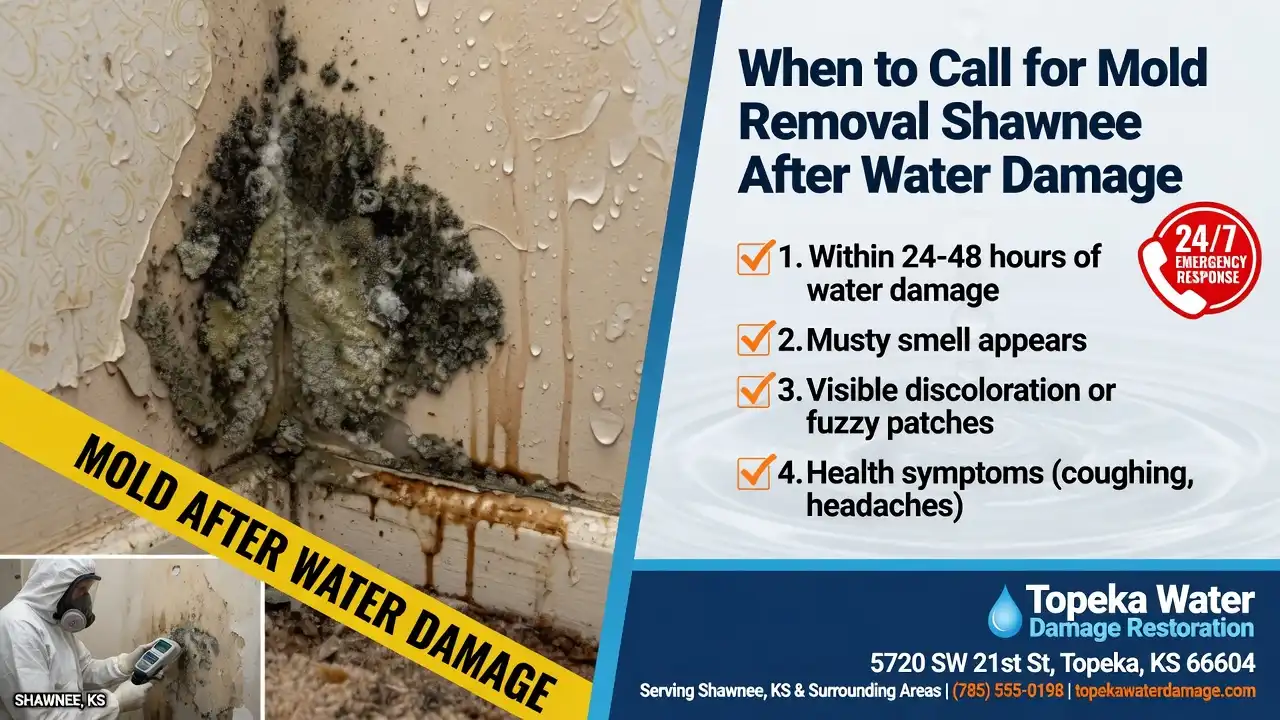
When to Call for Mold Removal Shawnee After Water Damage
Mold does not wait. Give it a damp basement, a slow pipe leak, or leftover moisture from a Kansas thunderstorm, and it can spread across drywall in as little as 24 to 48 hours. That is the harsh truth we see every week on mold removal Shawnee calls across Topeka, Kansas. The bigger problem? Most homeowners do not spot it until the musty smell hits or a family member starts coughing. By then, the colony has already settled behind walls and under flooring. This guide breaks down what actually works, what it costs, and how to protect your home before mold turns a small leak into a five-figure repair.
Key Takeaways
- Mold can grow within 24 to 48 hours of water exposure, so fast drying is your best defense against costly remediation.
- Category and severity determine cost. Small surface mold may run a few hundred dollars, while hidden structural growth can climb into the thousands.
- DIY works only for small patches under 10 square feet. Anything larger, or tied to sewage or ongoing leaks, calls for certified pros and proper containment.
Why Mold Is Such a Problem in Topeka Homes
Kansas weather sets the perfect table for mold. We deal with humid summers, sudden downpours, and hard winter freezes that burst pipes overnight. On recent emergency calls in Topeka, our crews found mold thriving in three usual spots: flooded basements, under kitchen sinks, and inside HVAC systems. Older homes across Shawnee County are especially prone, since many have limited waterproofing, aging plumbing, and poor ventilation.
Here is the part people miss. Mold needs only three things to grow: moisture, a food source, and time. Your drywall, wood framing, and carpet padding are all food. So once water sits, the clock starts ticking fast.
The Health Side of the Story
Mold is not just an eyesore. According to the U.S. Environmental Protection Agency, exposure can trigger allergic reactions, asthma flare-ups, and respiratory irritation, especially in kids and older adults. That is why we treat every mold job as both a structural and a health concern.
How Fast Does Mold Grow? A Realistic Timeline
If you have ever dealt with a flooded basement in Topeka, this timeline makes complete sense. The faster you act, the less you pay.
| Time After Water Exposure | What Happens | Your Best Action |
|---|---|---|
| 0 to 24 hours | Materials absorb water; no visible mold yet | Extract water, start drying |
| 24 to 48 hours | Mold spores activate and begin growing | Professional drying, dehumidification |
| 48 to 72 hours | Visible mold appears; musty odor starts | Containment and remediation needed |
| 1 to 2 weeks | Colonies spread into walls and framing | Full mold removal and repairs |
| 2+ weeks | Structural damage, air quality drops | Extensive removal and rebuild |
The lesson is simple. The first 48 hours decide everything. This is why our rapid response crews aim to be on-site fast when Shawnee County homeowners call.
Understanding Water Damage Categories
Not all water is equal. The type of water behind your mold problem changes the whole cleanup approach. These follow IICRC industry standards, the same benchmarks our certified techs work by.
| Category | Water Source | Risk Level | Example |
|---|---|---|---|
| Category 1 | Clean water | Low | Broken supply line, rainwater |
| Category 2 | Gray water | Moderate | Dishwasher, washing machine overflow |
| Category 3 | Black water | High | Sewage backup, river flooding |
Here is the catch. Clean water does not stay clean. Category 1 water can drop to Category 2 within 48 hours, and Category 2 slides to Category 3 soon after. So a “minor” leak in a Topeka basement can become a serious contamination job if it sits over a weekend.
Immediate Steps to Take When You Spot Mold
Before we arrive, these steps protect your family and limit the spread. Do not skip the safety gear.
- Stop the moisture source if you can safely reach it, like shutting a water valve.
- Keep people and pets away from the affected room.
- Turn off HVAC so spores do not travel through ducts.
- Do not scrub or disturb heavy mold; it releases spores into the air.
- Take photos for your insurance claim.
- Ventilate only if it does not spread spores to clean areas.
- Call a certified team for anything beyond a small patch.
One quick tip: never paint over mold. It hides the problem but never solves it, and we end up removing both the paint and the colony later.
DIY or Call the Pros? Here Is the Honest Answer
We believe in straight talk. Some mold jobs are safe to handle yourself. Many are not.
You can likely DIY when:
- The area is under 10 square feet (roughly a 3×3 patch)
- It is on a hard, non-porous surface like tile
- The water was clean (Category 1)
- There is no ongoing leak
Call a professional when:
- Mold covers more than 10 square feet
- It sits inside walls, ceilings, or HVAC
- The source was sewage or flood water
- Someone in the home has respiratory issues
- You smell mold but cannot find it
The FEMA and EPA homeowner mold cleanup guidelines back this same 10-square-foot rule. When in doubt, get an inspection. It is cheaper than guessing wrong.
Repair vs. Replace: What Can Be Saved
One question we hear on every mold removal Shawnee job is, “Can we save this?” It depends on the material and how deep the growth goes.
| Material | Usually Salvageable? | Notes |
|---|---|---|
| Solid wood framing | Often yes | Can be dried and treated if caught early |
| Drywall | Sometimes | Replace if soaked or moldy through |
| Carpet padding | Rarely | Absorbs water; usually replaced |
| Insulation | Rarely | Traps moisture; typically removed |
| Tile and concrete | Usually yes | Non-porous, cleans well |
| Upholstered furniture | Sometimes | Depends on saturation and water type |
Our rule of thumb: porous materials that stay wet too long get replaced. Trying to save them often costs more in repeat mold visits.
What Does Mold Removal Cost in Shawnee County?
Cost is the elephant in the room, so let us be transparent. Pricing depends on size, location, and severity. These are realistic ranges for the Topeka, Kansas area.
| Job Scope | Typical Range | What It Covers |
|---|---|---|
| Small surface mold | $300 to $800 | Single small area, hard surface |
| Medium remediation | $1,000 to $3,500 | One room, some material removal |
| Large or hidden mold | $3,500 to $7,000+ | Multiple areas, structural work |
| Whole-basement flood mold | $6,000 to $15,000+ | Extensive removal and rebuild |
| Mold air testing | $250 to $600 | Lab analysis and clearance |
Two things push cost up fastest: delayed response and hidden growth behind walls. Both are avoidable with quick action.
Our Mold Removal Process, Step by Step
When our team handles mold removal in Shawnee County, we follow a proven order every time.
- Inspection and moisture mapping to find every wet spot
- Containment with plastic sheeting and negative air pressure
- Air filtration using HEPA scrubbers
- Removal of contaminated porous materials
- Cleaning and treatment of salvageable surfaces
- Drying and dehumidification to hit safe moisture levels
- Clearance testing to confirm the mold is gone
We document each phase so you and your insurer see exactly what happened. No shortcuts, no vague invoices.
Preventing Mold Before It Starts
The best mold removal is the job you never need. Use this checklist to protect your Topeka home year-round.
- Fix leaks fast, even small drips under sinks
- Keep indoor humidity below 50% with a dehumidifier
- Insulate pipes before Kansas winter freezes
- Clean gutters so rainwater flows away from the foundation
- Run bathroom and kitchen fans during and after use
- Check basements monthly for dampness or musty smells
- Grade soil away from your foundation
According to the National Environmental Health Association, controlling moisture is the single most effective way to stop mold. Our extraction crews frequently see this in older Kansas homes where humidity control was overlooked for years.
FAQs
How long does mold removal take?
Small jobs finish in a day. Larger remediation with structural drying can run 3 to 7 days, depending on moisture levels.
Does insurance cover mold?
Sometimes. Coverage often depends on the water source. Sudden events like a burst pipe are more likely covered than long-term neglect. We help document claims either way.
Can mold come back after removal?
Only if moisture returns. That is why we always fix the source and verify dryness before we finish.
Is bleach good for killing mold?
For small hard-surface spots, maybe. But bleach does not reach mold roots in porous materials like drywall, so it is not a real fix for bigger jobs.
Other Services We Provide in Topeka, Kansas
- Emergency Water Extraction
- Mold Remediation
- Fire and Smoke Damage Restoration
- Sewage Cleanup
- Basement Flood Recovery
- Structural Drying
Business Name: Topeka Water Damage Restoration
Address: 5720 SW 21st St, Topeka, KS 66604
City: Topeka
State: Kansas
Country: United States
Service Area: Shawnee, KS and surrounding areas
Water damage and mold never keep business hours, and neither do we. Our crews are available 24/7 for emergency response across Topeka, Kansas, so call us the moment you spot trouble and we will start protecting your property right away.